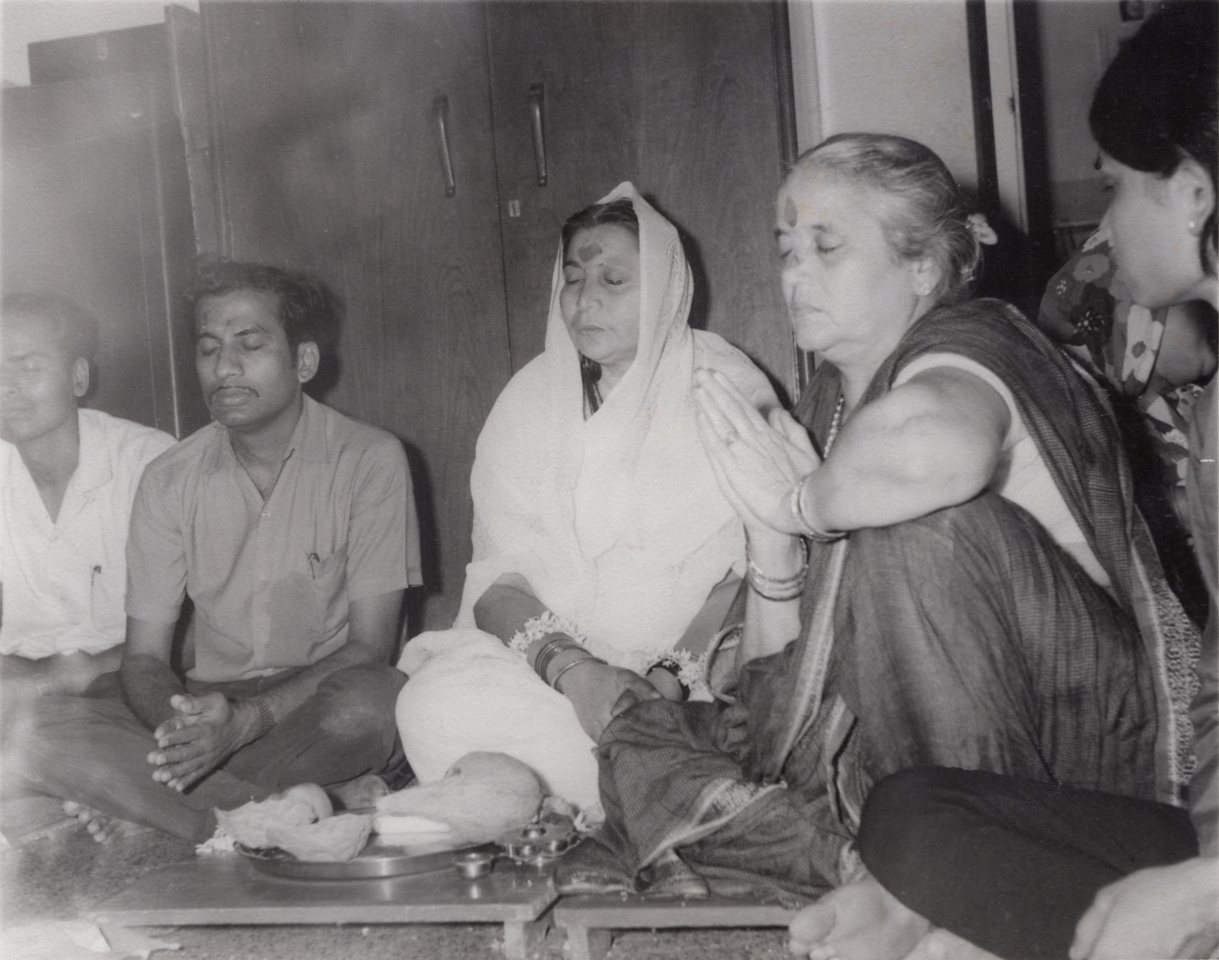
Shri Mataji Nirmala Devi in meditation, eyes closed, seated on the floor among seekers with folded hands, in a Sahaja Yogi's house in Maharashtra, 1972

Tension

Beyond Tension

Tension is the first calamity of modern times, and the more we develop, the worse it becomes. Across seven talks given over seventeen years, Shri Mataji explains where it comes from, why no effort can undo it, and how the grace of the awakened Kundalini soothes what the will cannot.

After Shri Mataji Nirmala Devi: Mumbai, 23 March 1973 · New Delhi, 3 February 1978 (translated from Hindi) · Caxton Hall, London, 13 November 1978 · Houston, 21 September 1983 · Bergenfield, 26 October 1985 · Krishna Puja, La Rochette, 9 July 1989 · Vancouver, 11 August 1990

I
The diagnosis

A Modern Disease

"There is another modern disease which we call tension."

In Delhi, in 1978, Shri Mataji names it plainly, and notes how new it is: "‘Tension’, People say ‘I have tension’, earlier nobody used to get tension."

A few months later, in London, she places it at the heart of our evolutionary crisis:

"The first calamity of the modern times is tension. You are tense, absolutely tense. For what? The more we have developed ourselves, the worse it is."

The calamities that pushed earlier beings to evolve came from nature. This one does not: "But today the calamities have come to us by ourselves." How we came to develop only outside is the subject of The Next Evolution.

II
The mechanism

You Cannot Relax Your Heart

"One puts you to tension, another one makes you absolutely restful."

In 1973, in Mumbai, Shri Mataji describes the two systems that govern our nerves:

"Now both these sympathetic and parasympathetic nervous systems are responsible, one for activity, another for inactivity. One constricts, another relaxes. One puts you to tension, another one makes you absolutely restful."

The first obeys our will. The second does not: "For example, you can, by working harder or running more, you can make your heart pulsate more; but you cannot relax your heart." And: "That’s not in your hands. They say there is some other force that is working which looks after the relaxation side of the heart."

That force is the one the yogis described: "The parasympathetic nervous system is the gross expression of that system which is in the spinal cord. In the spinal cord, we call it the Kundalini and the chakras."

The fuel of thinking

In Houston, in 1983, she shows what excessive thinking costs the body. The centre of action, in the abdomen, must constantly feed the brain:

"When we think too much, the grey cells in the brain have to be replaced. And who replaces them? The centers from your stomach which is this center which manifests the aortic plexus converts or transforms the fat cells from the stomach for the use of the grey cells. And when you start thinking too much, when you are futuristic, you are planning too much, then the whole extreme behaviour puts you out of gear."

The person becomes restless and quick to anger: "They are very irritable, they have no patience for anything, they are very angry people, hot-tempered, aggressive."

She calls the spleen the body’s speedometer: "Spleen in you is the speedometer." Our modern mornings, driving, eating, cursing the traffic and thinking of the office all at once, ask it to answer a dozen emergencies together. "It doesn’t know what to do, it becomes crazy. You are crazy and the spleen is crazy."

III
The root

The Ego That Plans

"What is the emergency?"

In Delhi she laughs at the seekers who hurry to her programme, anxious to arrive on time and to sit in front: "What is the emergency? Where will I go and where will you go? We will sit, relax, talk, and that’s how Sahaja yoga is done."

"The more you plan before coming here the more obstructions are created for your Kundalini awakening. Sahaja samadhi should come, it happens spontaneously."

Planning is the habit of the ego, and it prepares its own disappointment. In Bergenfield, in 1985: "Because ego will plan out, “Oh, we’ll go there, we must get for Mother, say, daisies”, we decide. “Must get daisies.” You don’t find daisies, you are disappointed. Why not? These are all My flowers, whether they are daisies or not, they look so nice."

"You know that, that the Divine is working out everything for you." And she gives her own example: "But otherwise I’m very calm, I am not bothered. I never organise you, I never hurry you, I never do anything that should upset you."

Punctual towards God

Punctuality has one true object: "Yes, we should be punctual in one thing, towards the call of God, that’s what we should be punctual about."

The rest is a race without movement. In 1989 she smiles: "I think sometimes people stand at the same point and start running thinking they are going to the airport: no movement, tense."

IV
Self-made

Tensions We Build Ourselves

"We build up our own tensions for everything."

In Houston, Shri Mataji watched some ladies choosing a ladle in a shop: "Hours they took to decide for a ladle." At dinner parties, half an hour goes into choosing the menu. "The whole joy of eating, the whole joy of meeting, everything is lost in that nonsense of decision."

"But on the contrary, so much time we waste on nonsensical things, and when we do that we develop funny diseases within ourselves, because we put our nerves to too much tension. It is too much of a tension for us. We build up our own tensions for everything."

In Vancouver, in 1990, she says it again: "We waste our energy in finding out what breakfast we will have, what lunch we will have, what dinner we have, what sort of a blouse we should wear. I mean such a lot of waste of energy, it’s a joyless pursuit."

Then the market offers to remove the tensions it helped to create. "Mentally you feel like that but the tension is all there."

The simple life

"Just imagine, it is such a simple thing to lead a life of simplicity. You need not be that complicated." All our norms of matching and sophistication serve one end: "All these stupid norms we have created, just to make ourselves miserable for nothing at all."

The tension finally reaches our nights. The mind that cannot stop, and the person who can no longer face himself, are described in The Next Evolution.

V
Balance

The Pendulum

"Between the two lies Sahaja Yoga."

Tension does not cure itself by its opposite. "If one goes to one extreme, then like a pendulum, if you go to one side then you start to go to the other side."

Overwork becomes boredom, and boredom looks for escape. "A Human being gets bored because he doesn’t know himself. When you know yourself then you get in a state of joy because you are so beautiful inside, so much organised and so sweet, that you don’t need anyone else."

The young who reject the madness of complication often fall into the other extreme: "So the young people decided, “Oh, get out of it, this is all nonsense, so let’s have anti-culture.” That’s another extreme." And: "Imagine, to compensate for this madness, take to another madness."

"Are we trying to be tense because we are over-alert, or we are trying to neglect everything because we want to escape? Between the two lies Sahaja Yoga."

Both extremes close us: "If you are in tension you cannot absorb my vibrations; or if you are lethargic also you cannot absorb my vibrations."

True relaxation is neither: "Relaxation never means lethargy, by any chance." It is a third state, which Shri Mataji defines in one line: "“Relaxed” means a person who is alert and calm." This culture of the alert and calm person is described in The Culture of the Spirit.

VI
The way out

Grace on the Nerves

"So, there is no need to be tense."

What the will cannot relax, the Kundalini soothes. In Vancouver, Shri Mataji describes what happens when she rises:

"Now, the Kundalini rises like this, goes up and She pushes all your attention inside automatically and then when it pierces through here, then the grace starts falling on your attention, on your sympathetic nervous system and it soothes down."

No struggle is needed: "you don’t have to fight with your thoughts, you don’t have to stop your thoughts, nothing, it just works automatically."

"Tension comes because you have imbalances but when you are balanced and when you are connected to the mains and all the time the energy is flowing into you there is no question of tensions."

Forgiveness

In Houston, guiding the seekers to say "Mother, I forgive everyone", she adds: "You’ll feel very much relieved, you just try it. Half of your tension will drop away."

Trust

"Whatever happens is by the Divine Power." Trust is not passivity: "Divine Power is going to work through your institutions, through your medium, so you have to be alert."

Most of our worries are out of proportion: "It’s like a bubble: we are worried about a bubble, as if it’s an atomic bomb or a hydrogen bomb." A simple farmer who had given Realization to thousands answered her, when she asked if he was comfortable, that the Eternal would look after him. "Means when you are worried about the eternal, when you are in the eternal, why are you worried about these transitory things?"

From the boat to swimming

"Spirit gives your attention the light and Spirit is the source of joy, as if you were getting drown in the waves of your thoughts and worries and problems. Suddenly you find you are in a boat and you are enjoying everything. You are seeing it."

"When you see your problem you can solve it better and there is the Divine power to solve all the problems that you have, then you learn how to swim." In 1989: "But when we are in the ocean of joy and bliss, we are not drowning, we are swimming; so we have to swim."
VII
Daily life

Sit, See, Enjoy

"The way to stay in balance is to sit, to see, enjoy."

The remedy Shri Mataji gives in Delhi is disarmingly simple:

"Now I say that you stay in balance. The way to stay in balance is to sit, to see, enjoy. In the morning the sun rises, see the sky, such beautiful colours come. They go away wasted, unseen."

"So many people we meet, we meet everyone and go away without meeting anyone, we part our ways as strangers." We invite a friend and turn on the television. "We never sit down, relax and talk to anyone for even 5 minutes." Yet: "Friendship comes when two people enjoy together."

And friendship is the surest sign that tension has gone: "I mean with a friend you cannot be tense, you cannot be! That is the first sign." The bond of friends is the subject of Growing Together.

The heart opens

"So, first of all we have to know that if we can reduce our tensions the heart will open. Heart has to open."

Time for meditation

"We have watches in the hand. All the time watching one minute, two minutes, three minutes and what do we do with it?" The time saved has one purpose: "But, if we have watches, it is for what? It is for us to save time for meditation. But meditation is needed only about five-seven minutes in the morning and ten minutes in the evening, not much time."

How to meditate is described in Mana and Prana.

"After all, we are now in the ocean of joy and bliss. Why should we have any tension?"

Shri Mataji Nirmala Devi, Krishna Puja, La Rochette, 9 July 1989