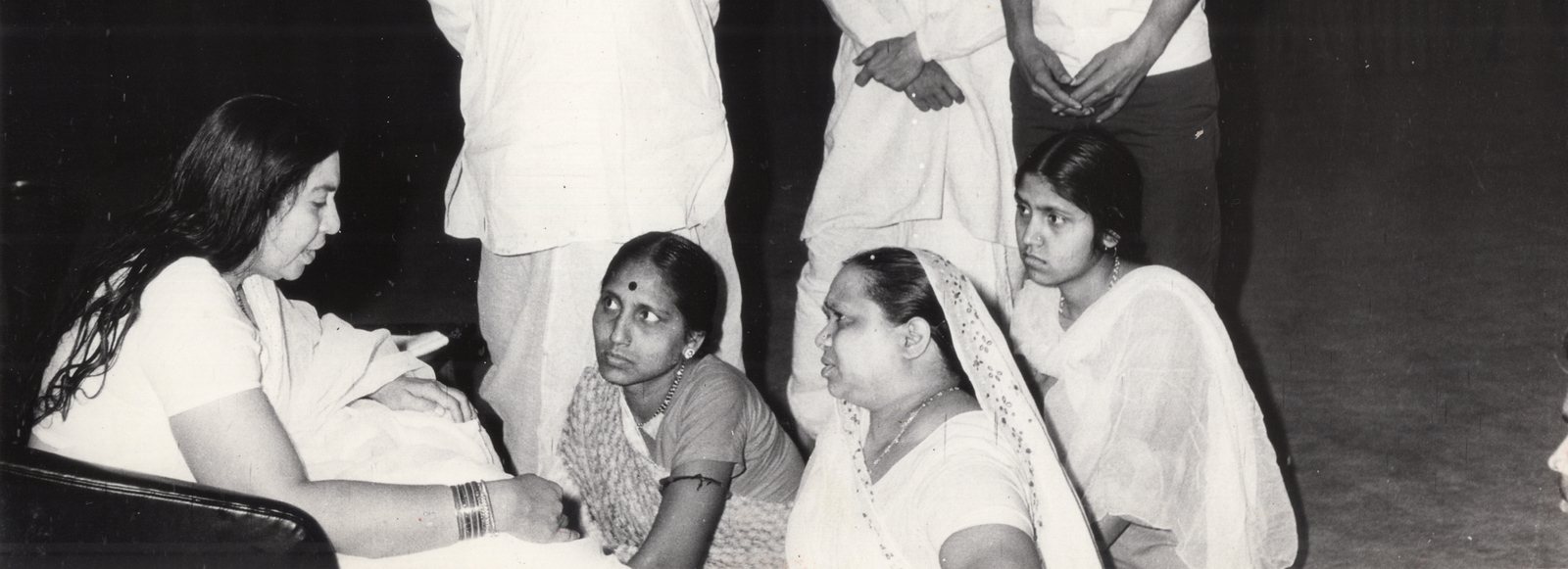
Shri Mataji Nirmala Devi speaking with seekers seated before her, while others stand and listen

Evolution

The Next Evolution

The human being is not the end of evolution. From the amoeba to us, life has risen spontaneously, without any effort of ours. In this public talk, Shri Mataji shows how we lost our way by developing only outside, and why the next step, the evolutionary jump of Self-realization, is already built into us.

After Shri Mataji Nirmala Devi: Evolution Beyond Organized Religion, public programme, Caxton Hall, London, 13 November 1978

I
Existence, creation, sustenance

The Three Powers Within

"It is really amazing the way God has placed us."

The Earth spins at tremendous speed among billions of stars, and we stay on it without falling off. The oceans and the mountains keep their measure, the sun and the moon keep their distance. Three powers, invisible to our senses, work within us, and we can see their manifestation very clearly.

To exist

The first, on the left side, is the power of existence: "And how kindly He has created us, and He makes us exist, not only that, but the desire to exist is the strongest in the human beings." Its other face is destruction: "If you have the light, then you can see the light all around, but when the light goes out it is darkness."

To create

The second, on the right side, is the creative power by which the whole universe was made: "And, within us, this power gives us the power to create, to think, to think for the future and this power comes to us by the force that God has within Himself by which he creates." No animal paints. "It is the human being only who can reflect what God has created, and produce something that looks like what God has created."

To sustain

The third, in the centre, is the most mysterious: the power of sustenance, which gives each element its valency and each being its nature. Only the human being is free to keep it or to betray it: "Only human beings are capable of being not genuine."

"We have got sustenance power, which is in a very simple way expressed in the bible as Ten Commandments. These are actually within us, we have achieved them through our evolution! We are the highest in the evolution."

The two side channels and their energies are described in Mana and Prana.

II
The spontaneous ascent

Not the End of Evolution

"This is not the end of evolution."

"From Amoeba to this stage how we have come why we have come, nobody can explain." And the human being still does not know why he is here: "What is their purpose? What are they supposed to do here? All these have come to us through this central power of sustenance."

The central path has two sides. One looks back: "We have been animals, we have been Amoeba, we have been matter." The other looks towards what we are going to be.

"But the other side is that you have to evolve, the future. This is not the end of evolution. This is definitely to be known that it is not the end of evolution."

"The human beings have not evolved to their complete fulfilment!" Everything so far has been given: "The evolutionary stage so far has come to you spontaneously. You didn’t do anything about it."

The incarnations

"And this evolutionary power had been given to us by God. He Himself in different aspects incarnated on this Earth, to give a new impetus, a new awareness within human beings to rise and to achieve their goal."

Krishna taught that the Spirit cannot be killed and that we are that eternal being. "Christ proved it by his life, by his resurrection."

III
The challenge

The Call of Adversity

"Now the whole evolution has worked on this point."

The first humans lived in fear of rain, earthquakes and calamities. "That fear built up in their mind an idea that there must be some power, which is beyond this, which can control these horrible forces which are trying to trouble us."

Each step of evolution was born of such a challenge: "When the fishes found that the food in the sea was not sufficient, nor they were safe any longer in the water, they asked for help within themselves and an incarnation came, they say, which crossed the sea and brought them to the shore."

"In the same way, today, at the modern point where we are, when we see all kinds of tensions coming up, when we see there are funny atrocities which we cannot explain, and we feel our existence being challenged at this juncture we have to evolve, we have to get out of it, we have to do something to get out of it."

"The first calamity of the modern times is tension. You are tense, absolutely tense. For what? The more we have developed ourselves, the worse it is."

The difference is that this time the danger is of our own making: "But today the calamities have come to us by ourselves." The atom bomb is the symbol of it: "It is not going to discriminate whether you are American, Japanese or Chinese or German."

IV
Organized religion

Development Outside

"How can you organise God?"

To face life, we built houses, railways, cars and aeroplanes. "But the idea of God was lost." The change shows even in what we teach: "In the beginning, philosophy was the most important subject. All the students were taught first philosophy. Then, now economics is the most important subject. Just the opposite of that."

"The findings of the seers, the findings of the great incarnations the teachings of the great scriptures and all that were lost because they said – “If you have to find your joy and happiness you have to go within.” But all the development was outside, and we forgot that balance."

"Even in the name of religion, we did that." Religion became a building, a sermon, a contribution. "Even for the seeking that must be inside, you have to pay." Yet no scripture asked for this: "Nobody thought that we had to seek God. We have to find Him out. Not by these artificial methods, of creating monasteries or temples or big organisations or sanghas and all those things, but by seeking Him within!"

The Buddha never founded his teaching on a monastery: "All the time what He said – “You have to meditate, and you have to meditate, and you have to meditate.”"

Science, a gift for meditation

"The creative power of God gave us, revealed to us, the knowledge of science." Machines were meant to free our time: "He did it because He thought you had no time for meditation." Instead, the freed time was filled with more running. "The matter is sitting on our heads."

"So the whole thing became nothing but a money-oriented business enterprise. I mean, God has nothing to do with money, I must tell you that very frankly."

V
Sun and moon

Time and Death

"So, the time and death, these two things were created for us to evolve."

On the left is the moon: "Now the moon as I told you is responsible for our existence because the moon governs our heart, and once the heart stops we are finished." We know it, and we forget it every moment: "We forget every moment that we are going to die, but we are conscious, in the subconscious mind we know that we are going to die."

On the right is the sun: "So the sun He created here for us to give us time." Time and death are not punishments. They are the problems that push us to evolve.

The mind that cannot stop

The first complaint Shri Mataji hears is: "Mother, I can’t sleep in the night." The real reason lies elsewhere: "Because you think by not sleeping, you are not giving rest to your body. But actually, you cannot face yourself."

"And this has come to us as a result of our thinking too much. We think too much."

She recalls the worker in Charlie Chaplin’s Modern Times who goes on tightening bolts in the air long after the assembly line has stopped: "The same kind of inertia works, you see, and the mind starts too much of thinking, too much of planning, too much of this."

VI
The purpose of religion

Build the Plane, Then Take Off

"Now you have to ascend, you have to go higher than that."

Where did we go wrong? We forgot what religion, the power of sustenance within us, was for.

"The purpose of religion was to stabilise you. To stabilise you. It was just to make you a human being and then to take you beyond."

"Like, as we built a nice, beautiful aircraft then we have to take off. And when the plane is perfectly alright, then we take off. But supposing we built an aircraft and go on building it, then we go mad! We have lost the purpose."

"After all, why have you sustained yourself? Why have you got your human being personality within you? For a purpose."

What is lost is joy

"You’re really frightened about it because by thinking, by your rationality you have realised one thing that you have gone wrong somewhere, because what is lost is joy. Nobody is happy!"

"In human relationships we have lost everything, we have lost the significance of love." And: "We have lost our genuineness, we have definitely lost ourselves somewhere, and we are so afraid and frightened of each other."

"While, do you know, all of you are the most beautiful flowers that God has created?"

After Realization, this beauty becomes perceptible as a fragrance, the vibrations flowing from each one. "That is possible only through your spontaneous evolution."

VII
Sahaja

The Evolutionary Jump

"It is with you!"

The next step cannot be bought, organized or imposed. It is already there.

"It is an evolutionary process built into you. That’s why is ‘sahaja’. ‘Saha’ means with, ‘ja’ means born. It is with you! The whole system is built into you! It’s all there!"

"It is an evolutionary jump which has been told to you that it will happen." But no one can make it for us: "But the conviction of this has to come from [an] inner search."

"I can feed you, but I cannot digest your food. Even if I do that, I cannot enjoy it. You have to enjoy it." And: "You have to experience it."

One sap, many trees

"Now, there can be a mango tree, there can be another tree which bears no fruits, there can be another tree which has got coconut, and all these trees are sustained by the sap in them. In the same way, God might have made you differently, you are built up differently, but the same thing is going to happen everywhere, and you are going to get it this way."

What it asks is simplicity and faith in oneself: "You see, after all, you have to believe in yourself!" A seed that germinates asks no questions, and the thinking mind cannot do it in its place: "By rationality, by thinking it will not work out, it is a spontaneous thing, with some people it works out, just like that!" The Kundalini that rises is described in The Living Yoga, and the seven centres she crosses in The Architecture of Joy.

Pearls on a thread

The first gift of this jump is a new awareness: "Once it enters into it and opens it out, the first thing that will happen [is] that you enter into the subtler existence of your being, which is the collective consciousness."

Shri Mataji compares us to pearls: "And there is a thread going through all of you. But, you are not yet connected by that thread." Once connected, we feel one another. "Collective consciousness is to be felt and seen."

Lao Tzu and Kahlil Gibran, she recalls, said that a day would come when all would know. And it must be many:

"If one person knows, supposing I am there, what’s the use? But if many will know, then only it will have its fulfilment!"

How the many grow together is the subject of Growing Together.

"When I say love, people get a fright, because God is nothing but love, and the truth and the joy. You’ll be amazed that after knowing that, you will think so far – whatever I have known was nothing!"

Shri Mataji Nirmala Devi, Caxton Hall, London, 13 November 1978